Rating
8
INFO
- Author: Peter Hessler
- NeoDB Douban Calibre Goodreads
Plot
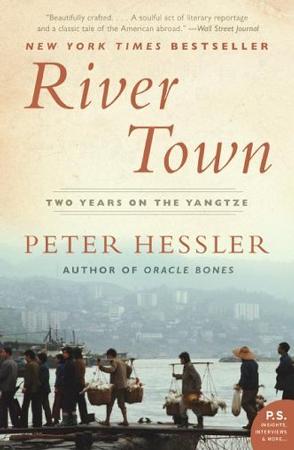
In the heart of China’s Sichuan province, amid the terraced hills of the Yangtze River valley, lies the remote town of Fuling. Like many other small cities in this ever-evolving country, Fuling is heading down a new path of change and growth, which came into remarkably sharp focus when Peter Hessler arrived as a Peace Corps volunteer, marking the first time in more than half a century that the city had an American resident. Hessler taught English and American literature at the local college, but it was his students who taught him about the complex processes of understanding that take place when one is immersed in a radically different society.
Review
It is important to understand what this book is, before rating it. I think the best genre to fit it in is Travelogue. And this book is a great travelogue, which happens to be about China in the 1990s.
A travelogue is a highly personal form of writing. It has a lot more to do with the writer himself than the travel destination. So each reader may have vastly different taste because the writer may show strong personality. I like Peter’s writing and I think this book will be liked by most readers because he is interesting, sensitive and more importantly, compassionate.
In addition, the two years Peter spent in China were some of the most eventful years to China. Fuling is also a great location, strange even to me who had spent 20 years in other parts of China.
However, this book probably is not journalism, not a historical account, not a sociology study. If you just want to learn more about China, or about the Reform and Opening-Up, you may read other material to get more information and faster.
Notes
- In terms of travelogue, I have read others like 失落的卫星, 深时之旅.
- The full book also included a recommended book list by the author.
- each chapter title is printed both in English and Chinese Calligraphy by Dai Xiaohong.
- Finished Part 1. In Part 2, the author ventured to Shaanxi during the summer break. The book is both fun and difficult to read, as it exposed some deep issues that still presents after 20 years. It is like looking at a x-ray report while listening to the doctor talking about it. I am both eager and terrified to learn the verdict.
- This book is also useful as it showed how some of the common Chinese phrase could be translated into English. I think most of the translations are very good and are now commonly used. But there are some poor attempts old hundred names. Another solution is sometimes the author would use pinyin directly, such as danwei, hukou.
- The book got me thinking: why did Peter write this? and why do people read it? After some time, inspired by his chapter about him talking to a Christian family (Luo) in Shaanxi Yulin, I think I have an answer. It’s because people like to chat. And writing and reading is just a forms of chatting that are preferred by a type of people. There are other forms of chatting: talking, music, sports, or even quarreling. No matter the format, people need to engage in communications with each other to understand one another, to share experiences, to learn, and to connect.
- And this book followed the recommendations by psychologists, i.e., you share more then usually the listener will also share more. Peter shared a lot, sometimes even too personal. That is very courageous.
- Following this, I think after 20 years, people are living in worse conditions. Now, our primary form of communication has changed significantly. Our communication is more one directional instead of two-way. People watch something on their phone, and that’s it. They might click the like button or post a venting comment, but that does not fulfill all the deep urge to communicate. That also explains why people need to keep scrolling; it just never feels enough.
- Ho Wei is only one guy. Although he is good, I wish there are more people, particularly more females, would write down their thoughts about China. This writer may not need to be a foreigner.
- The 48 hours train ride to Xinjiang reminds me of The Dispossessed
- Peter mentioned he wrote 4-5 hours every morning (during winter break). That’s very inspiring. Maybe I can be as good as Peter if I also spend several hours a day writing.
- The personal story of Peter himself in Chapter 9 Money hit me strongly. In 1997 in Fulin, Peter earned RMB 1000 a month which was twice the Fulin’s average but it was so little compared to US’s average income at the time ($120). So Peter decided to spend most of his salary, as saving tiny amount seemed silly. But 10 years after that in 2008, I had only RMB 500 per month stipend. I still decided to save some each month. I did not feel silly. Now we earn a lot more and we kept the habit of saving. I wonder in another 10 years, how will we evaluate our decisions?
- This part about money reminds me that most of people are only getting by. What they own really only make life not so bad. Money passed a certain level becomes intangible and meaningless.
- Money is just like one friend in our life. This friend may come and go, change his character, even become our enemy. But we will always have several friends at a time and we can always make new friends.